
This year marks 35 years since the Republic of Macedonia became independent following the breakup of the former Yugoslavia. The Football Federation of Macedonia (FFM), formerly known as the Football Association of Macedonia, has also operated independently for the same period.
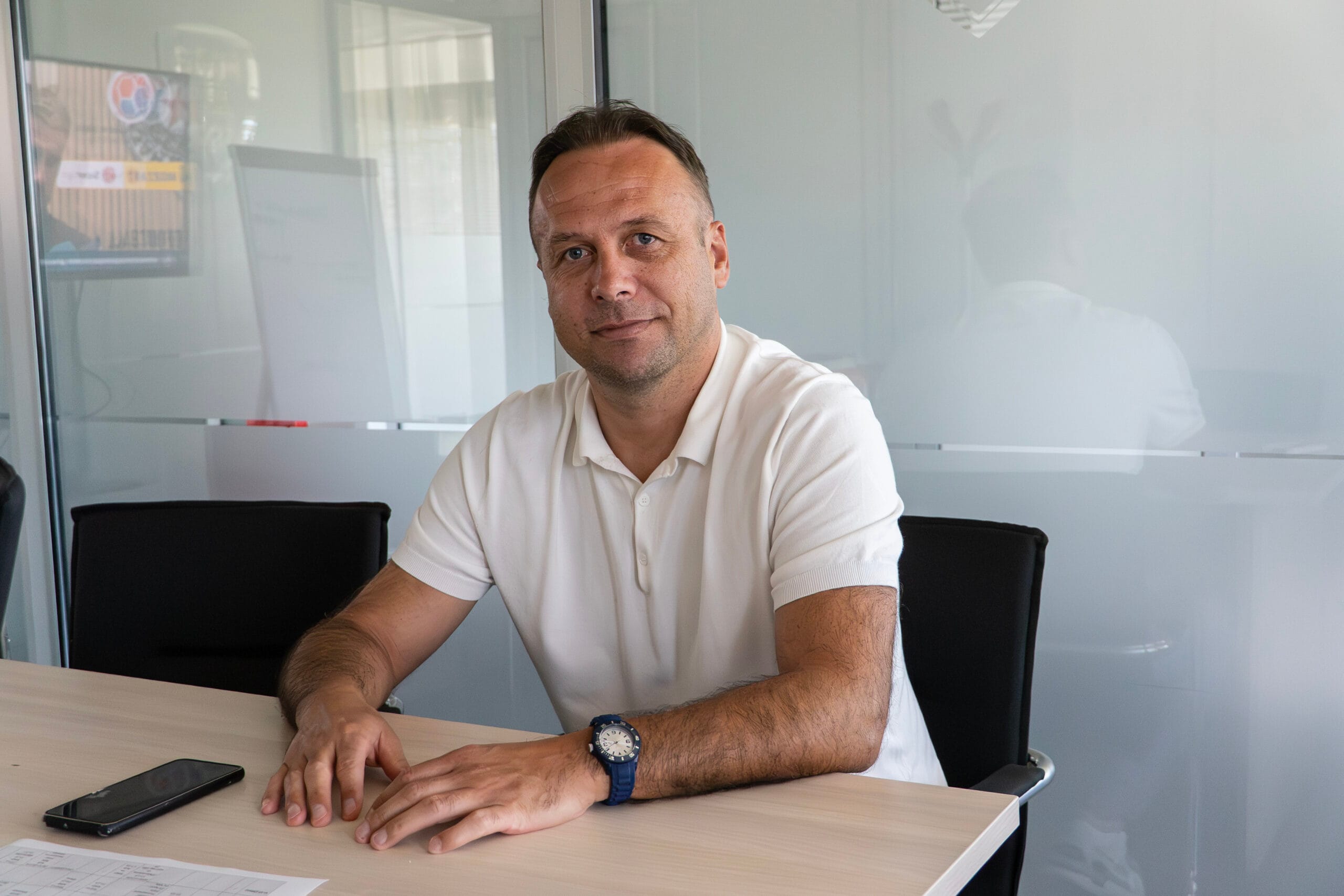
Nikolche Noveski, photo: FFM
Throughout these 35 years, one of the Federation’s most sensitive and challenging responsibilities has been identifying talented footballers of Macedonian descent around the world and persuading them to represent Macedonia internationaly. As a country with a large diaspora, Macedonia has increasingly come to recognize the vital role that diaspora players play in the success of national teams, including those ranked significantly higher on the world football stage.
Over the years, a large number of diaspora players have proudly worn the Macedonian jersey. However, the absence of a dedicated department within the FFM responsible for scouting and recruiting such players, combined with the improvised approach that existed in the past, undoubtedly costed Macedonia the opportunity to secure the services of players who could have helped the national teams achieve greater success and improve their international standing.
As part of its broader reform program, the new FFM leadership officially established a Scouting Department last October. Appointed to lead this newly formed body was former Macedonian international, national team captain, and one of the country’s most successful footballers abroad, Nikolche Noveski.
Noveski left Macedonia at the age of 19 and spent the following 17 years playing in Germany, including 10 seasons in the Bundesliga with Hansa and Mainz 05, where he also concluded his playing career after making 256 Bundesliga appearances. He earned 64 caps for the Macedonian national team. His appointment marked his official return to Macedonian football, this time in a different capacity.
Mr. Noveski, how did you come to be appointed to this important position?
First of all, thank you for the opportunity to talk about the Scouting Department at the FFM. After retiring from professional football, I needed some time away from the game to gain a different perspective, understand how the system functions off the pitch, and experience other aspects of life.
However, football has been part of my life since childhood, so the desire to return came naturally. When the new FFM leadership created the position of Director of Scouting, I didn’t hesitate for long before accepting the challenge.
Macedonia is widely regarded as a country with a large diaspora, significantly larger than the population living in the country itself. Are there enough quality footballers in the diaspora, and have you managed to establish a network of collaborators to help identify and monitor them?
Since this department did not exist until last year, we had to build everything from scratch. In a relatively short period, we’ve managed to organize ourselves and identify a large number of players with Macedonian roots living abroad.
It wasn’t easy in the beginning because we had virtually no database, while expectations from the public were understandably high. I would like to take this opportunity to thank everyone who contacted me with information about players of Macedonian descent. I also want to express my gratitude to several journalists, including your editorial team, who have made a significant contribution to building our player database.
Alongside me, there is another scout responsible for monitoring foreign-based players, as well as several scouts covering youth competitions within Macedonia. I have to point out that myself and the other officials in the current FFM leadership, like Goran Pandev, Ilija Najdoski and Gjorgji Hristov, use all our contacts to gather valuable information about our players in the diaspora.
Although we cannot yet compare ourselves to some of the larger football federations in the region, we do have a number of talented young players in the diaspora, and I believe that number will continue to grow.
Over the past 35 years, many players from the diaspora—particularly in the youth national teams—have received call-ups despite having questionable quality or playing in lower divisions. Since the Scouting Department was established, this trend appears to have declined, although it has not disappeared completely. There have still been a few debatable call-ups in certain youth teams. How closely do you work with the national team coaches, and how much influence can you have in preventing such call-ups in the future, especially considering your commitment to eliminating these practices?
The fact that you’ve noticed a decline in this trend confirms that we’re moving in the right direction, and I have no intention of changing that approach.
We work closely with all the national team coaches. Our responsibility is to identify as many talented young footballers as possible, increase competition within the youth teams, and provide the coaches with the widest possible selection of quality players.
Ultimately, however, the final decision regarding squad selection and playing time always rests with the head coach.
Your work involves many challenges — from the unrealistic expectations of players, parents and agents, to the fact that Macedonia cannot currently offer the sporting success or prestige of countries with stronger football traditions. How do you approach these challenges, and what is the key to convincing talented players to represent Macedonia instead of the country where they were born and developed?
There are many factors that influence a player’s decision to represent a national team, and unfortunately we don’t always have strong arguments based on past achievements.
We speak with the players, their parents, and their agents, and they need to be convinced by our vision. We present the current situation honestly while also outlining our long-term plans and explaining the role we see for each individual player within the national team setup.
Many football federations in the region and beyond actively organize training camps for diaspora players across Europe, the United States, and Australia. While such initiatives require considerable resources, is this something the FFM has considered as a long-term investment?
Yes, we’ve discussed this idea and have already spoken with members of the diaspora who have expressed an interest in helping organize such camps.
However, we would only organize them if we were convinced they would produce meaningful results. Holding camps simply to respond to public speculation or satisfy individual interests is not something we would consider.
Personally, I believe that if we organize such camps, they should focus on younger age groups, specifically players aged 14 and under, with the aim of identifying talented youngsters as early as possible in their development.
Nine months have passed since your appointment as Director of the Scouting Department. Are you satisfied with what has been achieved so far? What do you consider your greatest success, and is there anything you regard as a disappointment?
Generally speaking, I’m not someone who likes talking about myself, but I am satisfied with the work we’ve done, probably even more than I expected.
As I mentioned earlier, the number of call-ups for players of questionable quality has noticeably decreased, which I consider an important achievement. We’ve also managed to recruit several talented footballers who have strengthened our national teams.
Of course, I regret that we were unable to convince two or three other players to join us. However, I don’t see that as a personal failure because I know I did everything possible to persuade them. In the end, every player has the right to decide which country they want to represent, and we have to respect those decisions.
The FIFA World Cup is currently taking place in North America. Which team do you consider the favourite to win the tournament, and do you believe Macedonia can one day qualify for football’s biggest competition?
I’ve been following the World Cup with great interest because it’s an excellent opportunity to see how modern football continues to evolve.
We’ve already witnessed some outstanding matches, and now we’re entering the stage of the tournament where every game becomes even more exciting because there is no room for mistakes. We’ve also seen that even smaller football nations can progress through teamwork, discipline, and a winning mentality. There are several strong contenders for the title, but if I had to choose one, I would say France are the favourites.
As for Macedonia, I remain optimistic. I firmly believe that, with patience, proper planning, and continued development, we can one day qualify for a tournament of this magnitude.
I would love to know which players Macedonia couldnt convince to play for the national team. I hope they will try to convince a player like Nikola Sekulov, who played cuouple of games for the younger national teams, but desided to swtich for italy, where he became a captain for theyre youth teams.